Understanding Porto’s Riverside Character
Porto’s riverside is not one continuous experience. Ribeira is the busiest and most immediately historic, with compact lanes and postcard views; Miragaia feels quieter but demands more uneven walking. Massarelos spreads farther along the water, mixing grand buildings with former industrial spaces, while Gaia offers the broadest views back toward Porto—at the cost of a river crossing and additional distance.
For a short visit, the best choice depends less on seeing everything than on matching the route to your energy. Expect steep streets away from the waterfront, crowds around Ribeira, and slower progress than the map suggests.
Ribeira: Porto’s Historic Waterfront
Ribeira is the easiest district to choose when Porto’s historic character matters most and time is short. Start near Praça da Ribeira, where colorful façades, narrow lanes, and the Douro create an immediate sense of place. The waterfront is largely straightforward to follow, making it suitable for a first orientation walk, but the experience becomes less relaxed at midday, when restaurant terraces, tour groups, and river-cruise departures compress the promenade.
Reaching Ribeira from the upper city involves steep streets or steps, while staying beside the water limits architectural variety. Allow extra time for pauses and photographs, then climb gradually toward São Bento or the cathedral rather than treating the district as a quick riverside detour. Ribeira works best as a focused first stop; it is less convincing if you expect quiet streets or an effortless route onward.
Miragaia’s Layered Architectural Identity
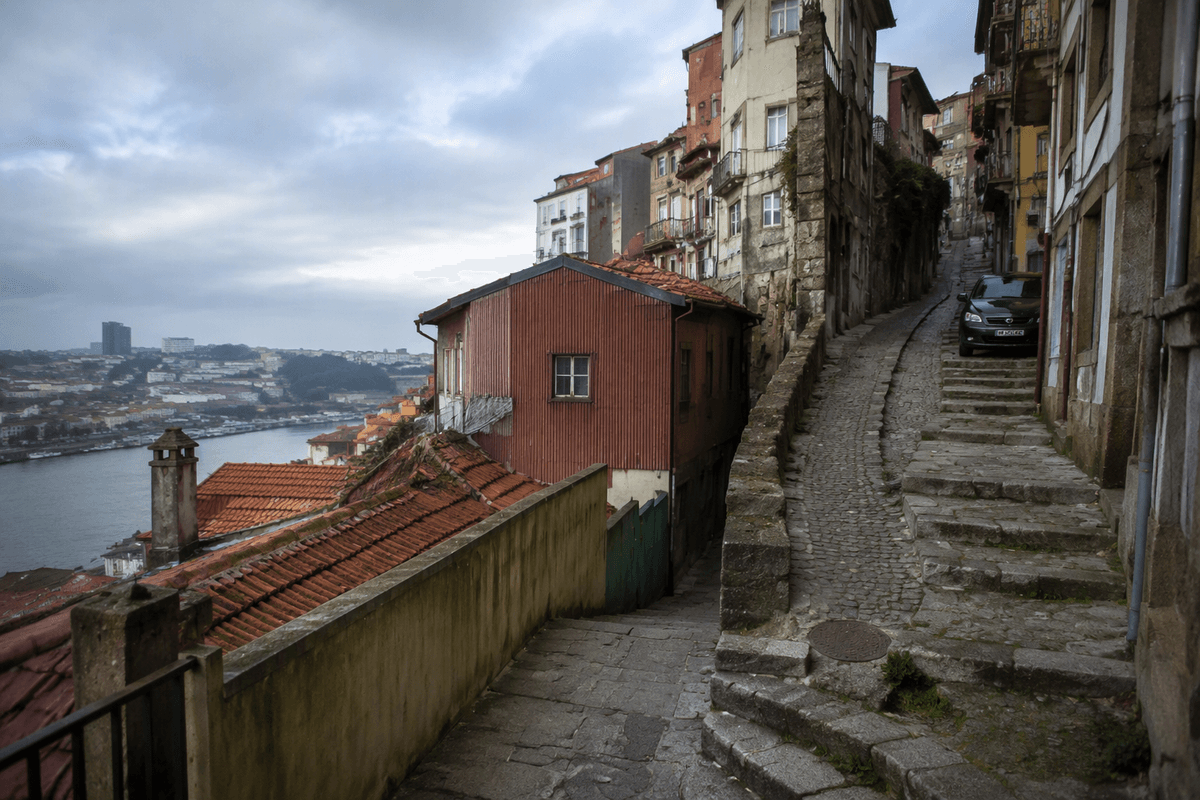
Miragaia rewards travelers who prefer architectural texture over Porto’s most obvious postcard scenes. Along the waterfront, narrow façades, old warehouses, and weathered walls reveal a district shaped by housing, trade, and the river rather than a single monumental style. It is quieter than Ribeira, which makes details easier to notice, but the promenade is less continuous and can feel interrupted by traffic, construction, or parked vehicles.
Streets rising toward the city are steep, and the uneven route can slow anyone working within a tight schedule. Stay near the river for a manageable visit, or continue west toward Massarelos if you want a longer architectural walk with fewer crowds. Miragaia is the better choice when atmosphere and layered façades matter more than covering several landmarks quickly.
Massarelos and the Industrial Waterfront
Continuing west from Miragaia, Massarelos feels more spacious and less theatrical. The riverfront opens around former warehouses, port-related buildings, and broad roads, while the architecture shifts from tightly packed historic façades to larger institutional and industrial forms. This makes the district useful for travelers who want a clearer sense of Porto’s working waterfront, but less satisfying if every stop must deliver an instantly recognizable landmark.
The route is flatter beside the river, although distances become deceptive: stretches between viewpoints can feel long, and traffic may interrupt the promenade. Massarelos works well in the late afternoon, when quieter paths and changing light offset the reduced concentration of attractions. With limited time, walk here only if you value atmosphere and urban context; otherwise, Ribeira or Miragaia will provide more architectural variety within a shorter circuit.
Vila Nova de Gaia Across the River
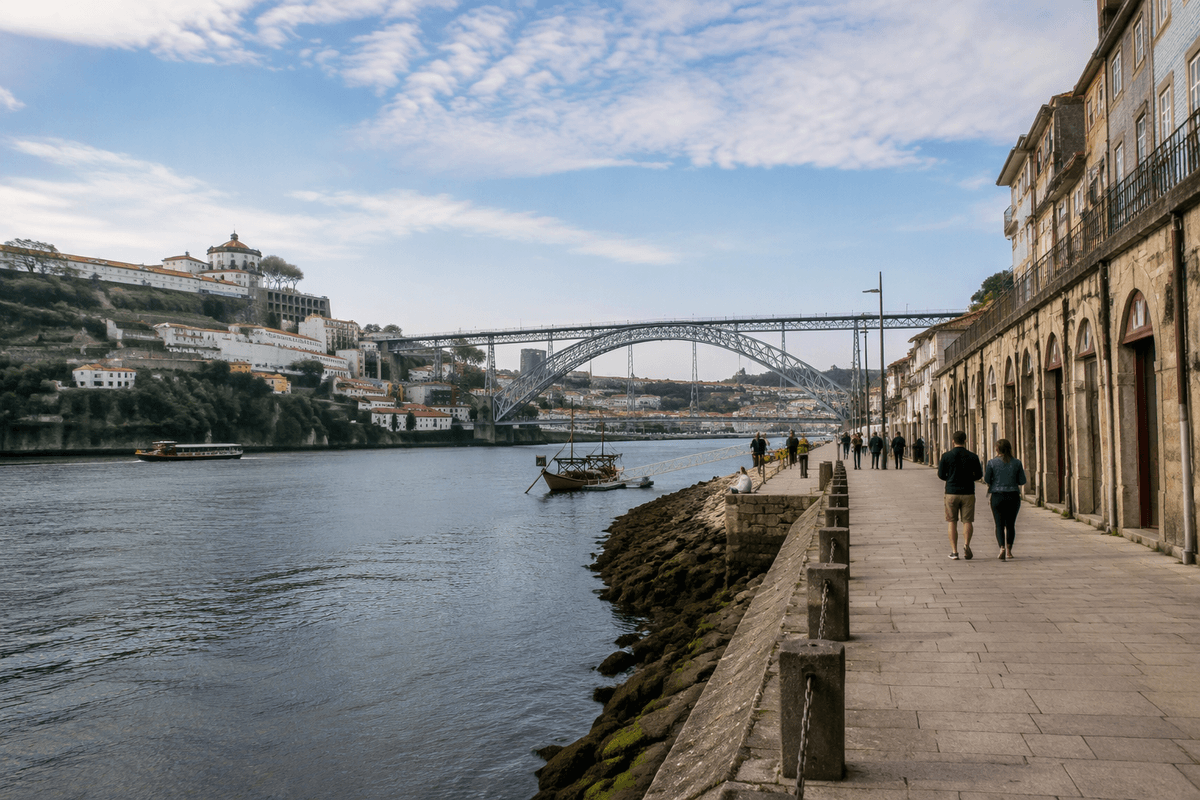
Gaia changes the view rather than simply extending Porto’s riverside. From the south bank, the historic center unfolds across the Douro, with the Dom Luís I Bridge and clustered façades forming a broader, more legible composition. The waterfront is easy to follow and often feels more open than Ribeira, but the promenade can become crowded near the port lodges, especially when cruise passengers arrive. It works best for travelers who want strong city views and wine-cellar architecture rather than close-up detail in Porto’s older streets.
Walking over the lower level is straightforward, while reaching higher viewpoints involves steep streets, steps, or a deliberate detour. If your schedule is tight, choose one Gaia viewpoint and return by transport rather than trying to cover the entire bank. Gaia is the strongest option for photographs and perspective, but less efficient for a compact architecture circuit.
Planning a Riverside Architecture Walk
With limited time, build the walk around one direction rather than trying to connect every district. A practical sequence is Ribeira to Miragaia, continuing toward Massarelos if energy and daylight allow. This keeps the route beside the river for much of the way, but the return becomes less convenient, so check transport before setting out. Gaia is better treated as a separate crossing, since adding it can turn a focused walk into a full afternoon.
Start early for clearer views and easier movement, especially in Ribeira and around the bridge. Wear shoes suited to slopes and uneven paving, and allow more time for photographs than the map suggests. If rain, fatigue, or crowds slow progress, stop at Miragaia or Massarelos rather than forcing the complete route; the architecture becomes less enjoyable when the walk turns into a distance challenge.
Choosing Your Riverside Experience
With only a few hours, choose Ribeira for concentrated historic character, Miragaia for quieter architectural detail, Massarelos for a longer and more spacious waterfront walk, or Gaia for the strongest views back across Porto. Trying to combine all four usually sacrifices the detail that makes each district worthwhile.
The best route is therefore the one that matches your priorities and energy. Start with Ribeira if uncertain, add Miragaia when the walk feels manageable, and treat Gaia as a separate viewpoint-focused outing rather than a rushed extension.